
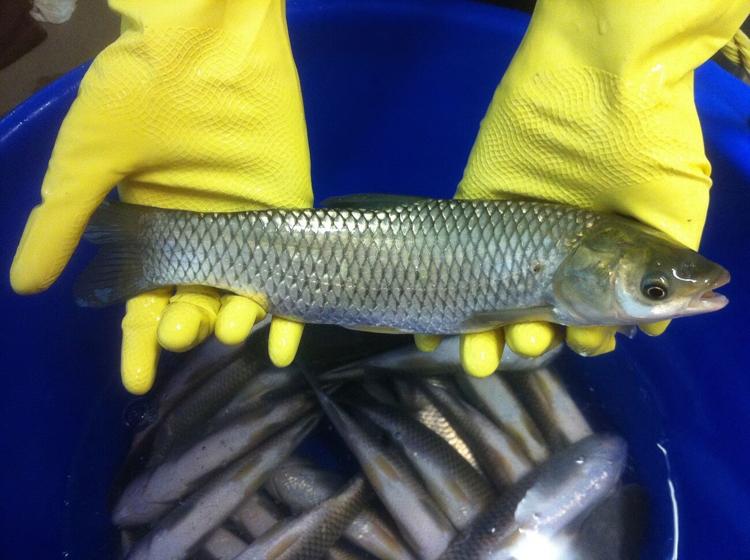
The Virginia Department of Wildlife Resources has once again OK’d stocking sterile grass carp into Smith Mountain Lake to control the spread of invasive aquatic vegetation — but this time at a much smaller amount.
The Tri-County Lakes Administrative Commission requested in April to stock 700 of the fish this summer into Smith Mountain Lake. DWR pared down that request with a permit for only 200 carp.
“DWR would only approve 200 carp,” said TLAC Executive Director Kristina Sage. “They thought anything more would be too strong of a response.”
The proposed number of carp needed to curb the spread of invasive hydrilla at the lake has dropped drastically since discussions started last year on how to control the underwater weed’s reemergence. Those early talks estimated a need for as many as 1,300 carp.
Hydrilla was first reported at Smith Mountain Lake around 2007. In the following years, TLAC spent more than $400,000 on herbicide to fight the weed. The herbicide would kill the plant for a time, but it would regrow the following year.
Hydrilla is known to grow thick enough to choke out coves and make boating difficult. It is also nearly impossible to kill.
In 2013, TLAC stocked 6,000 sterile grass carp at a cost of $32,000 to eat the hydrilla. The effort was successful at eradicating the weeds, but the carp also ate all other plants in the lake.
As the carp started to die off in 2023, native vegetation has started to return to Smith Mountain Lake — but so has the hydrilla. The weed has returned in areas where it had the highest concentrations back in 2013 and is starting to spread to other areas around the lake.
TLAC has estimated there is a total of 15 acres of hydrilla currently in the lake, mostly in smaller patches in areas less than 15 feet deep. The largest amounts can be found in the Bull Run and Little Bull Run areas of the lake.

Hydrilla, an invasive aquatic plant, is quickly making its return at Smith Mountain Lake after more than a decade. The underwater weed seen at the lake is pictured in 2025.
Do the fewer carp ease anglers’ concerns?
The commission sees the carp as the most cost effective measure to control the fast-spreading hydrilla, while anglers on the lake fear the carp could once again chomp up the native plants — which are useful in catching fish. Bass and other species often hide in the vegetation, making it a prime spot to cast a line.
Local anglers have been apprehensive about the proposal to once again stock the carp in the lake. Many felt the carp could impede the growth of the lake as a tourist fishing destination.
Chad Gilmore, president of the Smith Mountain Striper Club, applauds the scaled down approach the DWR is taking.
“The 200 sterile grass carp is a great step toward a very measured approach to controlling non-native invasive hydrilla,” Gilmore told The Roanoke Times in a statement. “The angler position revolved around using science to not repeat the past mistakes of 2013 when too many SGC were stocked decimating the native vegetation in addition to the hydrilla.
“The recommendation moving forward is a three part management plan involving a limited number of SGC, spot herbicide treatment of heavily infested areas and yearly responsive mapping surveys,” Gilmore continued. “We look forward to our continued involvement with Virginia DWR, TLAC and the lake community to ensure that SML remains one of the top fishing and vacation destinations on the East Coast.”

Hydrilla, an invasive aquatic plant, is quickly making its return at Smith Mountain Lake after more than a decade. Lake resident Don Pollock looks at the underwater weed form a dock in Penhook in 2025.
Sage said TLAC plans to stock the 200 carp next month in the areas of Smith Mountain Lake that have the highest hydrilla concentration. In the fall, surveys will be done to see how much of an impact the carp had on controlling the hydrilla.
Sterile grass carp are known to prefer hydrilla over other plants. TLAC is hopeful the carp will eat the hydrilla and refrain from native plants.
If the hydrilla is found to continue spreading this fall, Sage said TLAC will work with DWR to discuss other options to curb the growth. No word on if those options will include additional carp.
In an effort to keep an eye on hydrilla’s spread, Sage said TLAC will create a subcommittee of weed monitors made up of volunteers from around the lake. Members will keep an eye on the hydrilla to assure it does not continue to spread.
Sage said any property owners interested in taking further steps beyond TLAC’s introduction of the carp can apply to Appalachian Power for a permit to contract licensed aquatic herbicide applicators and provide targeted remediation. Applications to apply for the permits are available at the TLAC office in Moneta: 400 Scruggs Road, Suite 200.
Jason Dunovant (540) 981-3324